

The Illusion of Security: Why Gaming Ecosystems Are the New Frontline for Cybercrime
- Dean Charlton

- 2 days ago
- 3 min read
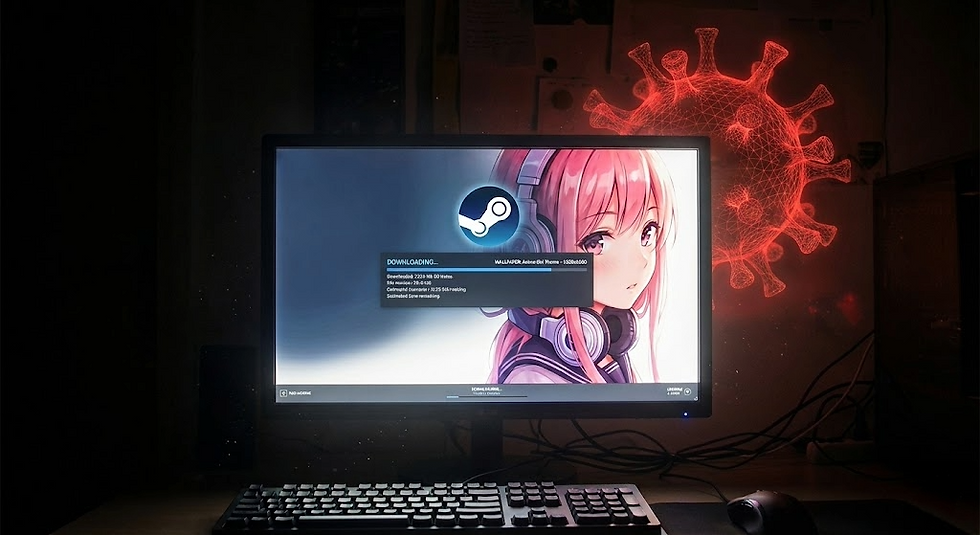
The recent discovery of malicious application wallpapers on the Steam Workshop has served as a sobering reminder that our digital trust is often misplaced. By leveraging Wallpaper Engine, a tool designed for creative expression, threat actors have found a seamless way to bypass traditional security perimeters, turning a community-favourite platform into a distribution vector for sophisticated malware.
The Evolution of the Digital Trojan Horse
This isn't a new concept, but the scale and delivery method have evolved. Historically, malware was often hidden in pirated software or suspicious email attachments. Today, hackers have shifted toward supply chain attacks, infiltrating the very ecosystems users trust.
The danger lies in the inherent convenience of modern gaming platforms. Users frequently download community-generated content, mods, maps, and, in this case, wallpapers, without a second thought. Because the Steam Workshop is a verified environment, the perceived risk is low. However, as cybersecurity experts have long warned, platform-based trust is not the same as software-level security.
"Trusted platforms can be abused to distribute malware: the attacks rely on users trusting content hosted within legitimate ecosystems,"
"While many of the malware families involved are well-known, the delivery mechanism enables attackers to reach large numbers of potential victims through seemingly harmless content."
Maxim Starodubov - Cybersecurity expert at Kaspersky.
The threat is significant not just because of the malware involved, but because of the "why" behind the downloads.
Wallpaper Engine is used by millions, and its "application wallpaper" feature is uniquely dangerous. Unlike a static image, these files are effectively Windows executables. When a user runs one, they are granting the file permission to execute code directly on their system.
This is a classic supply chain vulnerability. Attackers are not just targeting one user, they are poisoning the well for an entire community. Once a malicious package is uploaded and gains positive reviews or high download counts, it benefits from social proof, making subsequent users even more likely to download it.
This incident echoes the long history of "Trojan horses" in software. In the late 1980s and 90s, virus creators often disguised their payloads as games or utility software to trick users into running them.
The logic remains identical today: if you can convince a user that the software is "fun" or "useful," you are halfway to a successful compromise.
We've seen similar patterns in other ecosystems, such as:
Malicious Browser Extensions: Often disguised as productivity or ad-blocking tools, these frequently harvest data in the background.
Infected Open-Source Libraries: Developers downloading code from public repositories have occasionally imported dependencies that were intentionally backdoored.
Fake "Pro" Apps: Similar to the wallpaper campaign, these leverage the user’s desire for customisation to gain administrative access to their operating system.
The reality is that as long as platforms allow user-generated executables, the risk will persist. To keep your gaming PC and your accounts safe, consider these principles:
Practice Healthy Scepticism: Even on trusted platforms, treat any download that includes an "executable" or "application" component with extreme caution.
Audit Your Installs: Regularly review the content you have subscribed to in the Steam Workshop. If you don't recognise a file or no longer use it, remove it.
Use Endpoint Protection: Rely on robust, real-time security software. Modern solutions are increasingly capable of identifying anomalous behaviour like a wallpaper file attempting to modify system DLLs, even if the malware itself is new.
Enable Multi-Factor Authentication (MFA): This remains the most effective barrier against account hijacking. Even if a malicious wallpaper steals your session token, MFA can prevent the attacker from fully taking over your account.
Ultimately, the takeaway for the industry is clear: the line between "content" and "code" has effectively vanished. In an era where a desktop background can be a fully functional application, the responsibility for security is shifting from the platform developers to the end users, who must now act as the final line of defence.


Comments