

Cyber Siege: The Global Sectors Facing the Brunt of Digital Warfare

Cyber Siege: The Global Sectors Facing the Brunt of Digital Warfare
The global economy operates on a premiss where operational technology, cloud infrastructure, and sensitive consumer data are continuously exposed to malicious actors. Once considered an IT nuisance, cyber criminality has matured into an industrialised enterprise worth trillions of pounds annually. Across geographic borders, corporate networks are under relentless siege from nation-state actors, ransomware syndicates, and automated exploit bots. However, the distribution of these attacks is far from uniform.
Certain sectors bear a disproportionate burden of global cyber intrusions. Threat actors strategically target industries where operational disruption causes immediate financial or physical paralysis, or where concentrated repositories of personally identifiable information (PII) offer high-value extortion material. Based on global threat landscape telemetry from leading security researchers, including IBM X-Force, ENISA, and Verizon’s Data Breach Investigations, I've examined the top five sectors hit hardest by cyber attacks, explore structural vulnerabilities, assess the five-year trajectory, and detail the metrics shaping corporate defence.
The Top 5 Most Targeted Industries
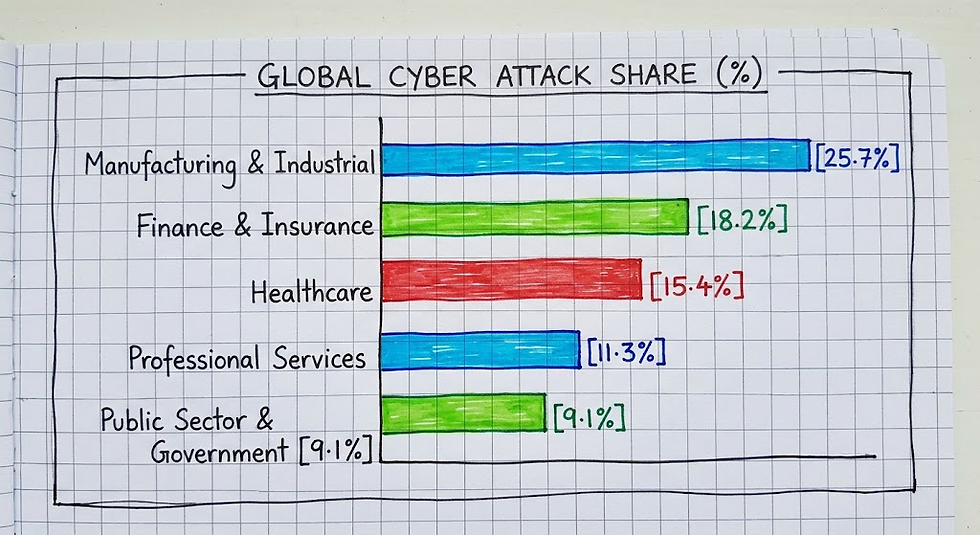
1. Manufacturing and Industrial Sectors (25.7%)
For multiple consecutive years, manufacturing has emerged as the single most targeted sector globally, absorbing over a quarter of all recorded cyber incidents. Conventional wisdom often attributes this vulnerability to a total absence of Governance, Risk, and Compliance (GRC) discipline, framing the industrial floor as an unmanaged, lawless frontier of outdated tech. However, empirical security benchmarks challenge this oversimplified myth.
Data from cross-industry security maturity surveys reveals that manufacturing's baseline security maturity scores actually sit near or above cross-industry averages (posting a Data Security Maturity Score of 43.0 against a general mean of 39.0). Industrial organisations regularly enforce rigid physical safety, environmental compliance, and quality control GRC frameworks.
The structural flaw isn't a lack of GRC, but rather a profound misalignment between classic IT risk management frameworks and the operational realities of the plant floor. Traditional GRC models prioritise data confidentiality, requiring frequent patching and downtime. Industrial manufacturing, by contrast, prioritises continuous uptime and physical safety. A factory floor running on legacy Programmable Logic Controllers (PLCs) cannot simply be taken offline for software updates without risking multimillion-pound production halts. Threat actors exploit this operational sensitivity to demand rapid ransom payments.
"Manufacturing isn't targeted because it ignores governance; it's targeted because traditional corporate GRC frameworks treat plant floors like corporate offices. Attackers know that an operational shutdown translates into immediate, catastrophic revenue loss, forcing manufacturers to consider paying a ransom far faster than an enterprise that simply loses access to spreadsheets." IBM X-Force Threat Intelligence Lead Analyst
The rapid adoption of Industry 4.0 has connected previously air-gapped operational technology (OT) to enterprise IT and supply chain software. While compliance teams may check the box for IT policies, only 5% of industrial firms maintain full visibility over OT assets in central security monitoring, leaving a dangerous gap between formal governance documentation and technical enforcement.
2. Finance and Insurance (18.2%)
Financial services institutions remain a primary target due to direct access to monetary assets and sensitive transaction data. Banks, asset managers, payment gateways, and insurance firms process vast sums daily, making them natural targets for direct theft, credential harvesting, and business email compromise (BEC).
While the financial sector maintains some of the most mature, heavily funded GRC programs worldwide, adversaries continuously adapt their methodologies. Instead of attempting direct breaches of hardened core banking databases, threat actors increasingly focus on third-party vendor compromise, open banking APIs, and cloud infrastructure.
"Financial services institutions have built formidable perimeter walls, so attackers have adapted. The modern cyber strategy against finance isn't a direct assault on the vault; it's compromising the supply chain software suppliers, API aggregators, and remote payment platforms that banks rely upon daily." European Financial Cybersecurity Advisory Board Director
The financial sector also faces severe regulatory exposure. Under frameworks such as the EU's Digital Operational Resilience Act (DORA) and the UK's FCA operational resilience requirements, a major breach triggers regulatory scrutiny, potential sanctions, and legal liabilities alongside operational losses.
3. Healthcare and Life Sciences (15.4%)
The healthcare sector accounts for more than 15% of global cyber attacks, but it suffers the highest financial penalty per breach of any industry. According to IBM's Cost of a Data Breach Report, the average cost of a healthcare breach exceeds £5.7 million ($7.4 million), reflecting extensive regulatory compliance fines, victim monitoring services, and operational remediation.
Healthcare systems are targeted because of the sensitivity of their data and the life-safety stakes of their operations. Electronic health records (EHRs) contain persistent personal data, including national insurance details, medical history, home addresses, and financial info. Unlike credit card numbers, which can be quickly cancelled, medical histories cannot be reset, giving patient records high value on dark web marketplaces.
"In healthcare cybersecurity, operational downtime isn't measured solely in monetary terms; it's measured in patient care delays, diverted emergency room traffic, and compromised life-support telemetry. Threat groups exploit this human urgency to demand inflated extortion sums." Chief Information Security Officer, NHS Foundation Trust
The rapid expansion of connected medical devices (IoMT), ranging from smart infusion pumps to remote heart monitors has created a wide attack surface. Many of these specialised endpoint devices lack built-in security controls, basic encryption, or patch management interfaces, making them entry points into broader clinical networks.
4. Professional and Business Services (11.3%)
Law firms, accounting practices, management consultancies, and marketing agencies represent high-value targets because they serve as gateways to corporate secrets. Professional service providers hold intellectual property, merger and acquisition details, litigation strategy, and privileged executive communications from corporate clients.
By breaching a single tier-one law firm or auditing group, cyber adversaries gain access to confidential files across hundreds of enterprise clients. This "island hopping" tactic allows attackers to bypass corporate perimeters by abusing trusted access channels.
"Professional service firms are the ultimate proxy target. Cybercriminals recognise that compromising a law firm or financial auditor often yields far richer intelligence on a multinational corporation than trying to breach the corporation directly." Senior Partner, Cyber Forensics & Incident Response
Small and medium-sized professional service firms often lack dedicated internal security operations centres (SOCs). They rely on basic IT setups while handling highly sensitive client data, creating a structural imbalance that attackers systematically exploit.
5. Public Sector and Government (9.1%)
Government institutions, municipal councils, national defence contractors, and civil services experience roughly 9% of global attacks. The motivations behind public-sector targeting are split between financial extortion via ransomware and geopolitical espionage.
Local government authorities are targeted by ransomware groups because they manage essential civil infrastructure, including tax records, public housing, utility routing, and emergency services. Public-sector entities often operate under constrained municipal budgets, legacy IT infrastructure, and recruitment challenges for cybersecurity staff, making system maintenance difficult.
"Government agencies are fighting a two-front war. On one side, organised cybercrime groups seek to hold public administration systems hostage for ransom. On the other, state-sponsored APT groups systematically breach infrastructure to gather intelligence and establish persistent backdoors." Director of Policy, Global Cyber Security Forum
Concurrently, Advanced Persistent Threat (APT) groups aligned with nation-states target defence, foreign affairs, and critical civil databases for espionage, sabotage, and long-term intelligence gathering.
Sectoral Vulnerability and Breach Impact Summary
To illustrate the systemic impact across these five sectors, the following summary compares attack share, primary adversary motivations, key entry vectors, and average data breach costs.

Structural Threat Drivers: Dissecting the GRC Disconnect
Understanding why these specific sectors suffer the brunt of global attacks requires looking past simplistic accusations that targeted industries simply ignore governance. Instead, the root issue lies in operational disconnects across GRC architectures.
1. The GRC vs. Operational Reality Gap
The assumption that manufacturing ranks first because it lacks compliance processes collapses under empirical scrutiny. Manufacturers maintain rigorous safety and regulatory frameworks, yet standard GRC models treat security as a policy enforcement exercise for office workstations.
When corporate risk registers evaluate digital assets, they frequently use generic IT checklists that fail to capture physical plant dependencies. This disconnect creates "paper compliance," where a manufacturer passes audit requirements while operating OT networks with zero central detection visibility.
2. Third-Party Governance Overreach and Oversight
Supply chain relationships create systemic exposure. In industrial sectors, over 40% of security breaches originate via vendor or contractor access. While corporate GRC policies mandate third-party risk assessments, over 54% of manufacturers admit they do not actively vet third-party technical credentials before granting access to internal networks. The governance policy exists, but the technical enforcement mechanisms are missing.
3. Identity and Credential Vulnerabilities
Attackers increasingly bypass technical security perimeters by logging in with valid credentials harvested via automated infostealers or dark web dumps. Traditional GRC frameworks enforce password rotation schedules on paper, but fail to mandate hardware-based Multi-Factor Authentication (MFA) across legacy OT jump-boxes, leaving door keys in plain sight for threat actors.
The Prediction For The Next 5 Years:
The threat landscape over the coming five-year horizon will be shaped by artificial intelligence, geopolitical realignment, regulatory pressure, and architectural changes in corporate defence. The target rankings across industries will adapt to these structural shifts.
1. AI-Driven Attack Automation and Deepfake Fraud
The deployment of artificial intelligence by threat actors is lowering the barrier to entry for complex cyber operations. Over the next five years, AI-powered social engineering will make traditional phishing identification training obsolete. Automated reconnaissance tools will continually scan public internet spaces for unpatched zero-day vulnerabilities, executing exploits within minutes of public disclosure.
Generative AI deepfakes incorporating real-time voice synthesis and video impersonation, will heavily target the Financial Services and Professional Services sectors. Executive impersonation will evolve beyond basic email requests for wire transfers into interactive, synthetic video calls designed to authorise multi-million-pound transactions or reset core administrative access keys.
2. Target Ranking Shifts: Energy, Utilities, and Infrastructure
While Manufacturing, Finance, and Healthcare currently top the attack statistics, the next five years will likely see a surge in attacks against the Energy, Utilities, and Transportation sectors. Rising geopolitical tensions have incentivised nation-state threat actors to map and gain persistent access to critical national infrastructure (CNI).
These intrusions are not always intended for immediate monetary extortion; rather, they serve as prepositioned access for strategic sabotage during geopolitical crises. Consequently, energy grids, clean water utilities, and maritime logistics networks will face increased probing and disruptive cyber attacks.
3. Ransomware Transition to Direct Data Extortion
Ransomware models are shifting away from system encryption toward stealthy exfiltration and direct extortion. Modern organization-wide backup strategies have made system recovery without paying a decryption key more viable for mature enterprises. In response, threat actors are increasingly stealing sensitive intellectual property, customer databases, and regulatory records without deploying disruptive encryption payloads.
Attackers then threaten to leak this data publicly, contact regulatory authorities to report privacy violations, or notify affected clients directly. This operational shift means that defensive focus must move from system restoration to data protection and exfiltration prevention.
4. Mandatory Zero-Trust Architecture and Regulatory Enforcement
To counter these emerging risks, regulatory bodies in the UK, EU, and United States are enacting mandatory cybersecurity standards. Over the next five years, compliance requirements will mandate Zero Trust Architecture where identity is continuously verified, access is strictly limited by privilege, and micro-segmentation is enforced across all operational environments.
Organisations that fail to implement cryptographic authentication, hardware-backed multi-factor authentication (MFA), and robust supply chain oversight will face severe fines, leadership accountability, and loss of operating licenses.
Defensive Strategies for High-Risk Sectors
To adapt to this threat environment, enterprises in high-risk sectors must re-evaluate their defensive postures. Defensive readiness requires moving beyond perimeter protection toward resilience, detection speed, and identity containment.

1. Aligning GRC directly with Operational Technology
Rather than imposing static IT compliance mandates onto production environments, organisations must build OT-specific risk registers. Risk teams need to audit operational dependencies under plant conditions, evaluating the true business impact of an operational shutdown alongside standard data loss metrics.
2. Identity-First Security and Hardware MFA
Since credentials remain the primary attack vector, organisations must adopt identity-first security architectures. Standard SMS or app-based push notifications are increasingly vulnerable to adversary-in-the-middle (AITM) phishing kits. Implementing FIDO2-compliant, hardware-backed authentication security keys provides resilience against credential harvesting.
3. Network Micro-Segmentation and OT Isolation
In manufacturing, healthcare, and energy sectors, micro-segmentation is essential to prevent lateral movement. Enterprise IT networks must be strictly isolated from operational environments and medical telemetry equipment via dedicated jump hosts, deep packet inspection firewalls, and restricted data flows. An intrusion in an administrative employee's email inbox should never grant access to a factory floor or a hospital operating room.
4. Continuous Supply Chain Auditing
Organisations must manage software supply chain risk actively. Security teams should require Software Bill of Materials (SBOM) documentation from software vendors, conduct regular third-party risk assessments, and enforce zero-trust network access (ZTNA) for external service providers.
The global cyber threat landscape has evolved into an asymmetric war of attrition. Manufacturing, Finance, Healthcare, Professional Services, and Public Sector institutions face targeted pressure due to the value of their operational availability and sensitive data repositories.
The belief that top-targeted industries suffer due to a lack of GRC processes misinterprets the data. High attack volumes stem from an operational gap between traditional corporate compliance mandates and real-world system dependencies. As AI automation accelerates the speed and scale of attacks over the next five years, organisations must bridge this gap by transitioning from passive, paper-based compliance to active, identity-centric resilience models. Operational continuity in an interconnected world depends on securing every identity, continuous network verification, and building systems capable of absorbing and recovering from cyber intrusions.
What's your thoughts?


Comments